
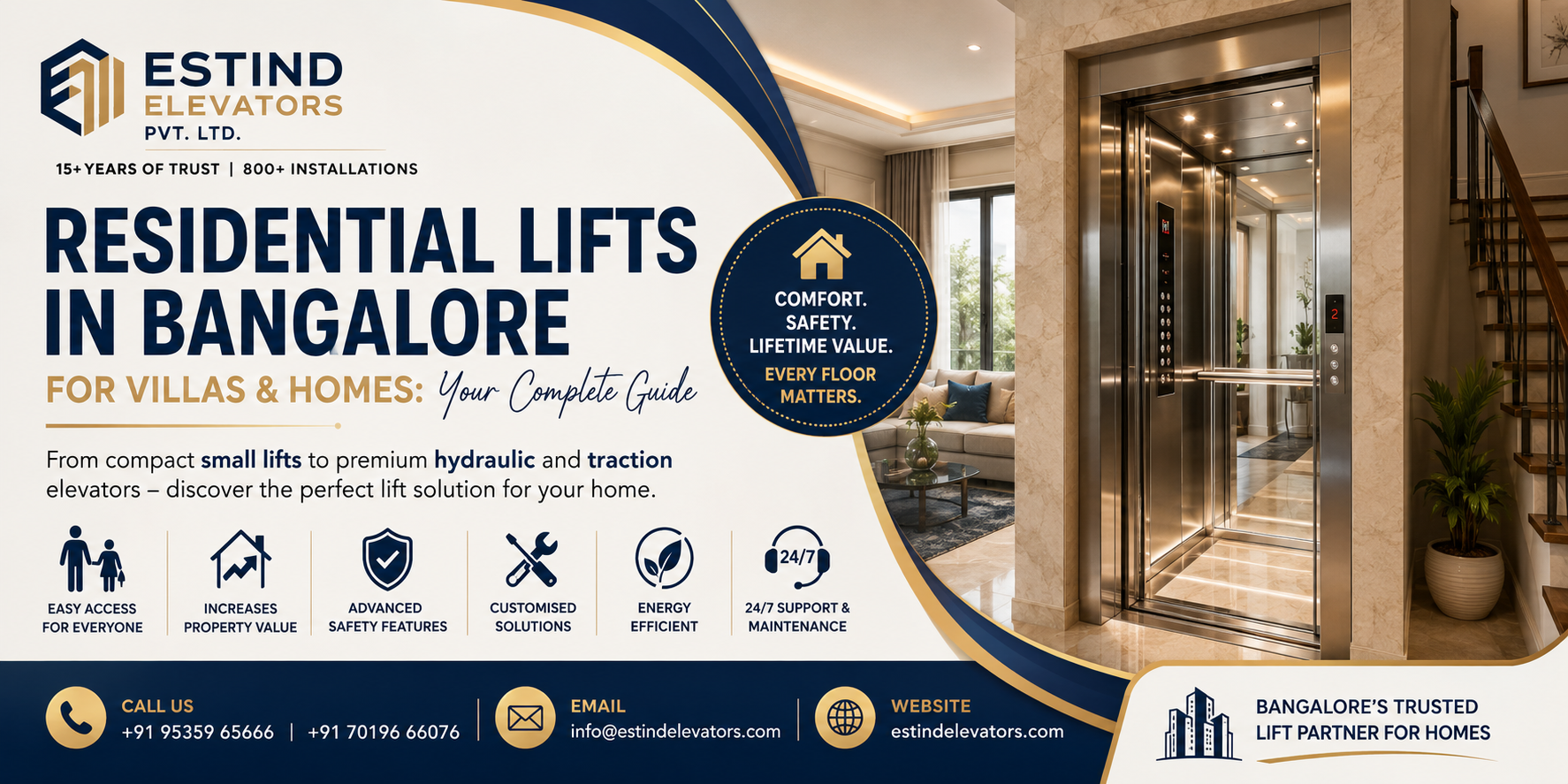
Bangalore is evolving rapidly. Luxury villas in Whitefield, multi-storey homes in Jayanagar, and independent houses across Sarjapur Road — vertical living is no longer a luxury but a lifestyle statement. And at the heart of this vertical living is one essential upgrade: residential lifts in Bangalore.
Whether you are building a new home or renovating an existing one, installing a home lift adds unmatched convenience, safety, and long-term value to your property. For senior citizens, people with mobility challenges, or families planning for the future, a lift for a residential building is not just a comfort feature — it is a necessity.
At Estind Elevators Pvt. Ltd., we have spent over 15 years helping homeowners across Bangalore choose and install the right lift solution. From compact small lifts for homes to full-sized hydraulic lift for home applications, our team brings expertise, safety, and style to every installation.
This guide covers everything you need to know — types of residential lifts, installation process, costs, safety considerations, and why Estind Elevators is among the most trusted lift companies in Bangalore.
Why Are Residential Lifts Becoming Popular in Bangalore?
Bangalore’s real estate market has shifted dramatically over the last decade. G+3 and G+4 independent homes are now common in neighbourhoods like HSR Layout, Koramangala, and Bannerghatta Road. As homes grow taller, the need for comfortable vertical mobility grows too.
Here are the top reasons why homeowners are increasingly investing in residential lifts:
- Aging population at home: With joint families being the norm, elderly parents need safe and easy access to upper floors.
- Increased property value: A home with a lift commands a premium resale price in Bangalore’s competitive market.
- Convenience for all ages: Carrying groceries, luggage, or heavy items up multiple floors is a daily challenge solved by a home lift.
- Future-proofing: A lift installed today ensures your home stays accessible for decades.
- Luxury appeal: A well-designed lift enhances the aesthetics and sophistication of a villa or bungalow.
The demand for small lifts for homes in Bangalore has surged, particularly in compact residential plots where space is a premium but mobility cannot be compromised.
Types of Residential Lifts Available in Bangalore
Choosing the right type of lift depends on your home’s structure, your family’s needs, and your budget. Let us explore the most popular options.
1. Hydraulic Lift for Home
A hydraulic lift for home uses a fluid-powered piston mechanism to move the lift cab smoothly between floors. This is one of the most popular choices for independent villas and bungalows in Bangalore.
Key advantages:
- Smooth and quiet operation
- No overhead machine room required
- Ideal for 2 to 4 floor homes
- Compact footprint, suitable for retrofitting
- Lower mechanical complexity means easier maintenance
Hydraulic home lifts are an excellent choice for villas in Hennur, Yelahanka, and other areas where independent houses span multiple floors. Estind Elevators offers customised hydraulic lift solutions with sleek finishes that blend seamlessly with your interior design.
2. Small Lift for Home (Compact Home Lifts)
If your home has limited space, a small lift for home is the ideal solution. These compact lifts are designed to fit within minimal shaft spaces while still delivering reliable vertical mobility.
Key advantages:
- Requires a smaller hoistway or pit depth
- Perfect for retrofitting into existing homes
- Available in 1–3 passenger capacities
- Energy-efficient operation
- Modern aesthetic designs available
Small lifts for homes in Bangalore are especially popular in row houses and older independent homes where structural modifications must be minimal. These lifts can often be installed within a 1.0m x 1.0m footprint, making them a practical choice for tight spaces.
3. Traction Home Elevator
Traction elevators use an electric motor and counterweight system for movement. These are suitable for homes with 3 or more floors and offer faster travel speeds compared to hydraulic systems.
Key advantages:
- Higher speed suitable for taller homes
- Energy-efficient through counterweight mechanism
- Smooth and reliable operation
- Available in geared and gearless variants
4. Pneumatic (Vacuum) Home Lift
Pneumatic lifts use air pressure differences to move the cabin up and down. They feature a distinctive cylindrical design and require no shaft construction.
Key advantages:
- No pit or machine room required
- Transparent cabin for a panoramic view
- Fast installation — typically 1–2 days
- Ideal for modern, designer homes
5. Through-Floor Lift
A through-floor lift moves directly through a cut-out section in the floor. It is one of the most space-efficient solutions and works well in homes where staircase space is limited.
Key advantages:
- Minimal floor space required
- Folds away when not in use
- Cost-effective solution for 2-floor homes
- Easy to operate for elderly users
Home Lift Installation Bangalore: Step-by-Step Process
Understanding the home lift installation Bangalore process helps you plan ahead and avoid surprises. Here is a step-by-step overview of how Estind Elevators approaches every residential installation.
Step 1: Site Survey and Assessment
Our technical team visits your home to assess the structural feasibility. We evaluate:
- Available space for shaft construction
- Floor-to-floor height
- Load-bearing capacity of the structure
- Electrical supply and access points
Step 2: Lift Selection and Design
Based on the site assessment, we recommend the most suitable lift type. Our design team customises:
- Cabin size and capacity
- Door type (automatic or swing)
- Cabin finishes — SS, glass, wood laminate
- Control panel design
- Lighting and mirror options
Step 3: Permit and Approvals
For residential lifts in Bangalore, certain installations may require municipal approvals or building NOCs. Our team guides you through the documentation process to ensure full compliance.
Step 4: Civil Work
This phase involves constructing the lift shaft (if required), pit excavation, and headroom preparation. Our partner civil contractors work in coordination with your builder or architect to minimise disruption to your home.
Step 5: Lift Installation
Once the shaft is ready, our certified technicians install:
- Guide rails and counterweights
- Machine and drive system
- Cabin and door assembly
- Electrical wiring and control systems
- Safety sensors and emergency communication
Step 6: Testing, Commissioning, and Handover
Before handover, every lift undergoes rigorous load testing, safety checks, and performance verification. We also provide a complete walkthrough of the lift’s operation, emergency procedures, and routine maintenance requirements.
Step 7: After-Sales Support and Maintenance
Estind Elevators provides structured maintenance contracts to keep your home lift in peak condition. Our team is available 24/7 for emergency support across Bangalore.
How to Choose the Right Lift for Your Residential Building
With several options available, selecting the right lift for residential building can feel overwhelming. Here are the key factors to consider.
Factor 1: Number of Floors
For a G+1 or G+2 home, a compact hydraulic or small lift is sufficient. Homes with 3 or more floors benefit from traction elevators that offer higher speed and capacity.
Factor 2: Available Space
If your home has limited interior space, a through-floor lift or compact pneumatic lift may be the best fit. For homes with ample space, you can opt for larger cabin lifts with customised interiors.
Factor 3: Usage Frequency
A lift used occasionally by one or two elderly family members has different requirements than a lift in an active family home. Higher-frequency usage demands a more robust drive system.
Factor 4: Budget
Home lift prices in Bangalore vary based on the lift type, cabin size, finish quality, and installation complexity. At Estind Elevators, we offer transparent pricing and flexible packages to suit a range of budgets.
Factor 5: Aesthetics
Your lift should complement your home’s design language. Whether your interior is contemporary, traditional, or minimalist, we offer a wide range of cabin finishes, door designs, and lighting options to match.
Factor 6: Safety Requirements
If the lift will be used by elderly family members or children, safety features such as anti-entrapment sensors, emergency lighting, intercom systems, and overload detection become critical considerations.
Safety Features That Every Residential Lift Must Have
Safety is non-negotiable when it comes to home lift installation. At Estind Elevators, every residential lift we install is equipped with industry-standard safety systems:
- Overload protection: Prevents the lift from operating when the weight limit is exceeded.
- Door sensors: Automatically halt door closing if an obstruction is detected.
- Emergency stop button: Allows the lift to be stopped immediately if required.
- Battery backup: Ensures the lift reaches the nearest floor during a power failure.
- Anti-fall device: Prevents sudden downward movement in the event of rope or cable failure.
- Emergency intercom: Two-way communication with the outside in case of entrapment.
- Manual lowering system: Allows technicians to safely lower the cabin during emergencies.
All our lifts comply with Indian standards for elevator safety (IS 14665) and relevant international standards.
Why Choose Estind Elevators for Residential Lifts in Bangalore?
With numerous lift companies in Bangalore offering home elevator solutions, why should you choose Estind Elevators Pvt. Ltd.?
15+ Years of Proven Experience
Since our founding, Estind Elevators has completed 800+ installations across residential, commercial, hospital, and industrial sectors. Our decade-and-a-half of hands-on experience means we have encountered and resolved every challenge imaginable in home lift installation.
Complete Integration Package
We are not just a supplier — we are your end-to-end lift partner. From initial consultation and design to installation, commissioning, and ongoing maintenance, Estind Elevators handles every aspect of your residential lift project.
7+ Products to Match Every Need
Our product range covers home elevators, hydraulic lifts, goods elevators, panoramic elevators, hospital elevators, passenger elevators, and more. Whether you need a small lift for home or a high-capacity traction elevator for a large villa, we have the right product for you.
Custom Design Capabilities
Every home is unique. Our design team works closely with you to create a lift that fits your specific space, load requirements, and aesthetic preferences. We offer custom cabin sizes, finishes, door styles, and control panel designs.
Transparent Pricing with No Hidden Costs
We believe in honest, upfront pricing. Our detailed quotations cover all aspects of the project — supply, installation, civil coordination, testing, and after-sales support — with no unexpected add-ons.
Pan-Bangalore Service Network
Our technicians are based across Bangalore, ensuring quick response times for both planned maintenance visits and emergency breakdowns. Whether your home is in Hebbal or Electronic City, our team is close by.
Customer-First Philosophy
At Estind Elevators, customer satisfaction is our core value. We are proud of the trust that hundreds of Bangalore homeowners have placed in us, and we work hard to maintain that trust with every project we undertake.
Small Lifts for Homes in Bangalore: A Closer Look
The growing popularity of small lifts for homes in Bangalore reflects the city’s unique housing trends. Many homes in Bangalore are built on compact plots but extend vertically to maximise space. A small or compact home lift bridges the gap between practicality and comfort in these settings.
What Makes a Lift “Small”?
A small home lift typically features:
- A cabin footprint of 0.9m x 0.9m to 1.1m x 1.1m
- Capacity for 1 to 3 passengers (approximately 225 kg to 340 kg)
- Travel speed of 0.15 m/s to 0.50 m/s
- Shaft depth starting from as little as 100mm pit depth
Where Are Small Lifts Most Commonly Installed?
- Compact independent houses: 30×40 or 30×50 BDA-approved sites with multiple floors
- Older homes being retrofitted: Where drilling large shafts is not feasible
- Duplex apartments: Where a lift between two levels is needed
- Senior citizens’ homes: Where safety and ease of use are paramount
Maintenance of Small Home Lifts
Small residential lifts require periodic maintenance every 3 to 6 months. Routine checks include lubrication, rope tension verification, door alignment, safety sensor testing, and control system diagnostics. Estind Elevators offers annual maintenance contracts (AMC) that cover all scheduled visits and unlimited emergency callouts.
Hydraulic Lift for Home: Is It the Right Choice for Your Villa?
If you own a villa in Bangalore — whether in Devanahalli, Sarjapur, or North Bangalore — a hydraulic lift for home is often the preferred choice. Here is why:
Advantages of Hydraulic Home Lifts
Smooth Ride Quality: Hydraulic systems provide exceptionally smooth acceleration and deceleration, making every journey between floors comfortable even for elderly passengers.
No Overhead Requirement: Unlike traction lifts, hydraulic lifts do not require a machine room above the shaft, making them easier to integrate into existing villa structures.
Compact Machine Room: The hydraulic power unit can be placed in a small room adjacent to the shaft — often just 0.5m x 1.0m — keeping the installation footprint minimal.
Lower Noise Levels: Modern hydraulic systems operate at noise levels well within comfortable residential thresholds, ensuring your home remains peaceful.
Durability: Hydraulic lifts have fewer moving parts than traction systems, translating to lower maintenance requirements and longer operational life.
Limitations to Consider
- Hydraulic lifts are generally more suitable for up to 4 floors.
- Energy consumption may be slightly higher than gearless traction systems.
- Oil leakage (extremely rare with modern systems) can be a concern, which is why quality installation matters.
Estind Elevators uses premium hydraulic components sourced from certified manufacturers, ensuring your villa lift delivers years of reliable, maintenance-free operation.
Cost of Residential Lifts in Bangalore
The price of a residential lift in Bangalore depends on multiple variables. Here is a general range to help you plan your budget.
Lift Type | Approximate Price Range (INR) |
Small Hydraulic Home Lift (2 floors) | ₹4,00,000 – ₹7,00,000 |
Compact Traction Home Elevator | ₹6,00,000 – ₹10,00,000 |
Pneumatic Vacuum Lift | ₹8,00,000 – ₹14,00,000 |
Full-Size Villa Lift (3–4 floors) | ₹10,00,000 – ₹18,00,000+ |
Note: Prices are indicative and vary based on customisation, cabin size, number of stops, and site conditions. Contact Estind Elevators for a precise quotation.
What Is Included in the Price?
A complete home lift installation package from Estind Elevators typically includes:
- Lift supply and all components
- Installation labour and supervision
- Civil coordination (not civil work cost unless specifically included)
- Electrical wiring within the shaft
- Testing and commissioning
- Operator training
- 1-year warranty on parts and labour
Final Words
Investing in residential lifts in Bangalore is one of the smartest decisions a homeowner can make — for safety, convenience, and long-term property value. Whether you need a hydraulic lift for home, a small lift for home in a compact space, or a full-featured villa elevator, the right lift solution exists for every home and every budget.
At Estind Elevators Pvt. Ltd., we combine 15+ years of installation expertise with a commitment to quality, safety, and customer satisfaction. Our team of certified engineers ensures that every home lift installation in Bangalore meets the highest standards of performance and safety.
If you are ready to explore your home lift options, reach out to us today. Our experts will conduct a free site assessment and provide a detailed, no-obligation quotation tailored to your home’s specific requirements.
Transform your home with a residential lift from Estind Elevators — because every floor matters.
Call Us: +91 95359 65666 / +91 70196 66076 , Email: info@estindelevators.com Website: estindelevators.com
Frequently Asked Questions About Residential Lifts in Bangalore
Q1: Is a permit required for installing a home lift in Bangalore?
In most cases, a no-objection certificate (NOC) from the building owner and compliance with local building by-laws is sufficient for residential lifts. Our team assists with all documentation requirements specific to Bangalore’s municipal regulations.
Q2: How much space is needed for a home lift installation?
A compact home lift requires as little as 1.0m x 1.0m of floor space for the shaft. The pit depth can be as shallow as 100mm for some systems. Our site assessment will determine the exact space requirements for your home.
Q3: Can a lift be installed in an existing home without major renovation?
Yes. Many residential lifts — particularly hydraulic and pneumatic models — are designed for easy retrofitting. Our engineers assess your home and recommend the least invasive installation approach.
Q4: How long does home lift installation take in Bangalore?
Depending on the lift type and site conditions, installation typically takes between 5 to 15 working days. Pneumatic lifts can be installed in as little as 1–2 days, while custom shaft lifts may take longer.
Q5: What is the maintenance schedule for a residential lift?
We recommend servicing your home lift every 3 to 6 months. Estind Elevators offers AMC plans that cover all routine maintenance visits and emergency support throughout the year.
Q6: How safe are home lifts for children and elderly users?
Modern residential lifts are equipped with multiple redundant safety systems including door sensors, overload protection, battery backup, and emergency intercoms. When installed by a certified company like Estind Elevators, home lifts are extremely safe for users of all ages.
Q7: What is the power consumption of a home lift?
Power consumption varies by lift type. A compact hydraulic or traction home lift typically consumes 2 to 5 units of electricity per day under normal usage, comparable to a domestic air conditioner.